
How Nigerian Sesame Seeds Are Priced: Season, Grade, Demand and FOB Lagos Explained
Sesame has no futures market, so the 'price per ton' you find online is usually stale. Here is what actually sets the price of Nigerian sesame and how to compare two offers properly.
"What is your sesame price per ton?" is the first question in almost every enquiry we receive. Unlike cocoa or coffee, sesame has no terminal market to anchor the number, so prices are discovered deal by deal between origins and buyers. That makes it more important, not less, to understand what sits behind a quotation.
1. Destination demand
A handful of markets set the tone. China is by far the largest importer and its buying pace moves the whole market. Japan and South Korea pay the highest premiums for clean, colour-sorted white seed. Turkey and the Middle East buy heavily for tahini and halva. India and Vietnam buy for crushing and re-export. When China is active, Nigerian FOB prices firm across all grades.
2. Season and supply
New-crop sesame arrives from November. Prices are typically softest from December to February when arrivals peak, firm through the second quarter as stocks are drawn down, and are highest from June to October before the next harvest. Weather in Nigeria and in competing origins — Sudan, Ethiopia, Tanzania, India, Myanmar — shifts the curve from year to year.
3. Grade and specification
Within one week, offers for natural white 99/1/1, brown mixed 98/2/2 and Sortex 99.5% can differ by hundreds of dollars per tonne. Processing cost (cleaning, colour sorting, hulling), the colour premium and testing requirements all feed into the differential. Compare offers only for identical specifications.
4. Incoterm
- FOB Lagos — includes haulage from the north to Apapa or Tin Can Island, export clearance, FPIS grading, terminal handling and loading on board. You arrange freight and insurance.
- CFR / CIF destination — FOB plus ocean freight (and insurance for CIF) to Qingdao, Tokyo, Mersin, Rotterdam or your named port.
- FCA / EXW — price at our warehouse or the Lagos terminal.
5. Packing and payload
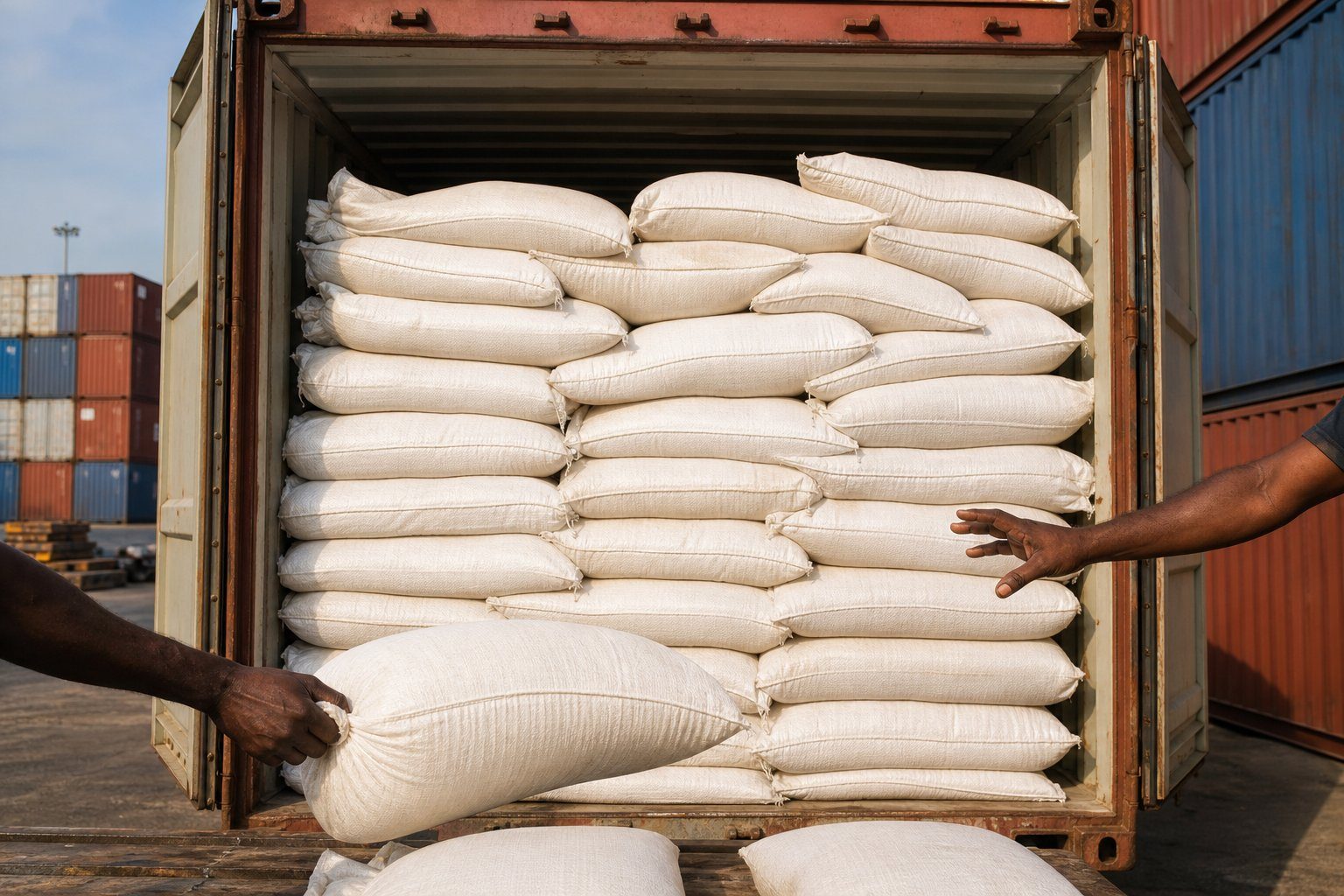
Sesame is heavy: a 20' container carries 19–20 tonnes in 50 kg PP bags or 21–22 tonnes loose in a flexi-liner. Because fixed container costs are spread over similar tonnage either way, packing affects price mainly through bag and liner cost. Make sure both offers assume the same packing and the same tonnage per box.
6. Testing and compliance
EU-bound sesame requires Salmonella testing and faces increased border controls; Japan and Korea require aflatoxin and residue certificates. Laboratory testing, and any steam sterilisation at destination, carry real costs. A quote that includes a full test certificate is not the same as one that does not.
How to compare two quotes
| Element | Incomplete offer | Complete offer |
|---|---|---|
| Price basis | "$X per ton" | USD per MT FOB Apapa, Lagos (Incoterms 2020), validity stated |
| Grade | "Sesame seeds" | Natural whitish sesame, purity 99% min, admixture 1% max, moisture 7% max, oil 50% min, FFA 1% max |
| Food safety | Not stated | Aflatoxin, Salmonella and residues to destination limits, lab named |
| Packing & tonnage | Not stated | 50 kg new PP bags, 19.5 MT per 20' FCL |
| Documents | Unclear | Full set listed, FPIS and lab certificates included |
| Payment & shipment | Not stated | LC at sight / deposit terms; shipment month stated |
We do not publish a list price because it would be wrong within a week. Instead we send a written, itemised offer within two business days that you can compare properly. Request your quotation here, or read our guides to sesame specifications and export documentation first.
Sourcing sesame seeds from Nigeria?
Get a written quotation and specification within two business days.
More Insights
Ready to Source Export-Grade Sesame Seeds from Nigeria?
Tell us your grade, tonnage, packing and destination port. Our export team will prepare a detailed FOB or CIF quotation and a sample plan.